A new floor changes far more than the look of a room. It changes the warmth underfoot on a winter morning, the way light sits across the space, and whether every furnishing feels properly considered. For homeowners and interior designers who do not want to compromise on finish, a wool carpet remains one of the finest choices available.
Its appeal is not simply tradition. Good wool carpet has natural resilience, depth of colour and a soft, substantial feel that synthetic alternatives struggle to replicate. Yet the quality of the finished room depends on more than choosing wool alone. Pile construction, colour, room dimensions, underlay and professional fitting all matter, particularly when the aim is a tailored, join-free result.
Why wool carpet remains a luxury choice
Wool is a natural fibre with an ability to recover after pressure, making it well suited to everyday living spaces as well as more formal rooms. A carefully specified carpet will retain a pleasing appearance under furniture and foot traffic, while its dense pile gives a room a quieter, more settled character.
It also has a distinctive visual quality. Wool takes colour beautifully, producing shades with depth rather than a flat, artificial appearance. This matters when a carpet needs to sit alongside painted joinery, upholstery, curtains or a particular wall colour. In a carefully planned interior, a near match is not always enough. The floor is a large visual surface, so even a slight variation can alter the balance of the whole scheme.
Comfort is another reason to choose wool. A deep-pile wool carpet, fitted over the correct underlay, provides genuine softness underfoot and adds insulation to bedrooms, lounges, stairs and dressing areas. It can also help soften sound within a room, an especially welcome quality in properties with hard finishes, high ceilings or open-plan spaces.
Wool does require sensible care. It is not the lowest-maintenance option for a busy entrance hall used by muddy dogs and wet shoes, for example. But in the right setting, with a suitable pile and regular maintenance, it offers long-term quality that makes its initial cost a considered investment rather than a decorative extra.
Pure new wool velvet or wool-rich twist?
The best construction depends on how the room will be used and the style you want to create. A 100% pure new wool deep-pile velvet carpet has a smooth, sumptuous surface and a particularly luxurious feel. It suits bedrooms, master suites, drawing rooms and refined reception spaces where softness and a polished appearance are the priority.
Velvet pile can show shading, footprints and vacuum marks more readily than a twist. This is part of its character, not a fault, and many clients value the changing light and movement across its surface. In a busy family area, however, a wool-rich twist can be the more practical choice.
An 80/20 wool-nylon deep-pile twist combines the natural look and comfort of wool with added durability from nylon. It is a strong option for halls, stairs, landings and frequently used living rooms. The twist construction helps disguise tracking and everyday marks, while still delivering a substantial, quality finish underfoot.
Neither choice is automatically better. A pure wool velvet may be exactly right for a calm, luxurious bedroom, while an 80/20 twist may make better sense for a hard-working staircase. The key is to choose for the room rather than applying one specification throughout the house without thought.
Choosing wool carpet colour with confidence
Off-the-roll carpet is often chosen from a limited palette, then made to fit the room as best it can. Bespoke manufacture turns that process around. The carpet can be produced for the scheme and made to the plan, allowing the colour, dimensions and finish to be considered together from the outset.
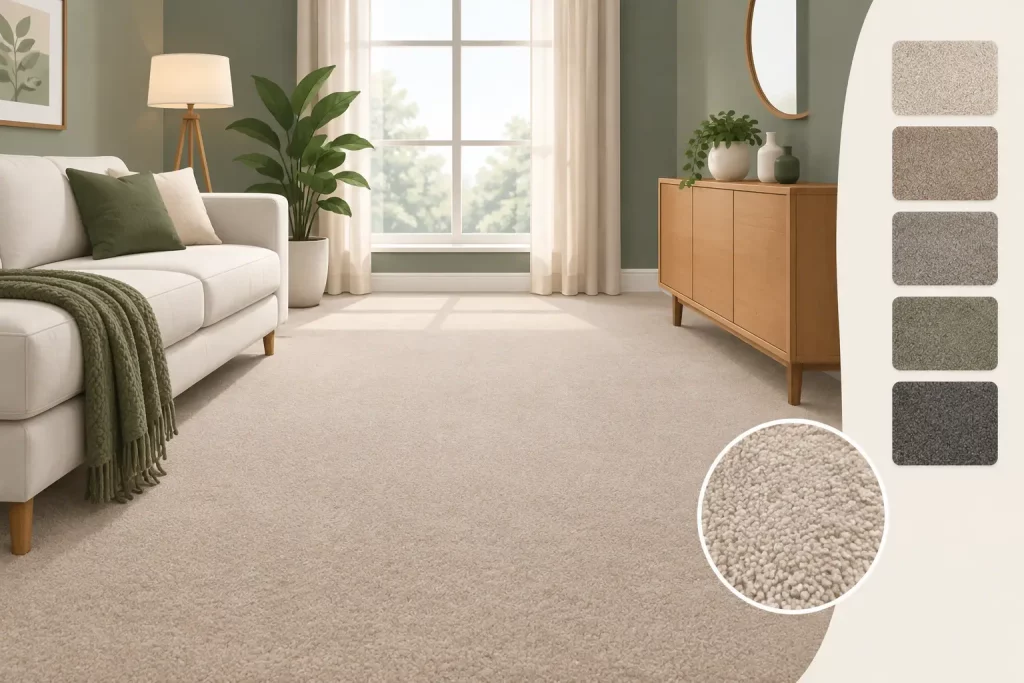
A neutral wool carpet is not necessarily a safe or simple decision. Warm greys, stone, oatmeal, taupe and soft beige can each read very differently beside natural daylight, LED lighting, timber flooring and painted walls. A grey with a blue undertone may feel crisp in one room and cold in another. A cream can look elegant against darker joinery but show more readily in a heavily used area.
This is why samples should be viewed in the actual room, at different times of day and beside the finishes that will remain. A small sample cannot reproduce the scale of an entire floor, but it will reveal undertones and texture far more accurately than a screen image. For an exact scheme, colour matching from a range of more than 3,000 options gives designers and homeowners much greater control.
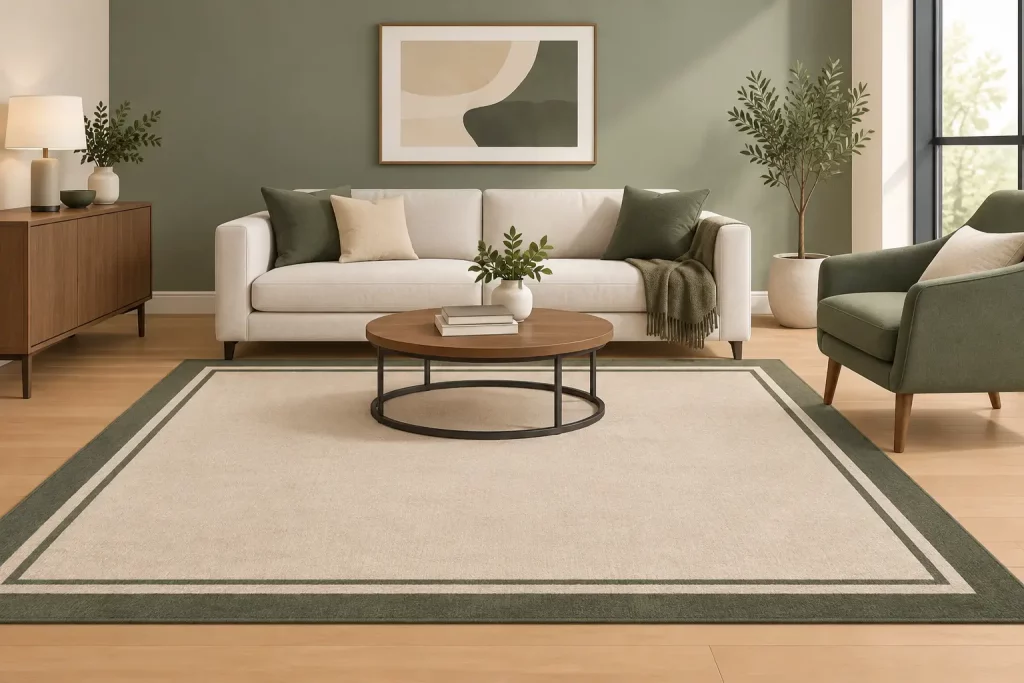
Borders can add another layer of definition. A self-colour border creates subtle structure, while a contrasting border can frame a seating area, echo a paint colour or define the edge of a large room. The proportions need careful planning. A border that is too narrow can disappear, while one that is too wide may make the central field feel constrained.
The difference bespoke widths make
Visible joins are one of the most common compromises in large carpeted rooms. Standard carpet widths often force a join across the floor, even where the rest of the interior has been planned to feel open and uninterrupted. Depending on pile direction, natural light and the position of windows, that join can become far more noticeable than expected.
Manufacturing carpet to wide widths, including dimensions up to 35 feet wide, makes it possible to cover many substantial rooms in one piece. The result is cleaner, more refined and visually calmer. It also avoids designing a room around the limitations of a standard roll.
Made-to-plan production is valuable in less obvious ways too. Bay windows, angled walls, fitted cabinetry and unusually shaped rooms can all create unnecessary waste when carpet is cut from stock. Producing to the required dimensions reduces surplus material and helps ensure that the price relates to the room you are actually carpeting, not to offcuts you will never use.
What a properly specified wool carpet should include
The carpet itself is central, but it is not the entire floor. Underlay affects comfort, insulation, support and how the pile wears over time. A high-quality underlay helps carpet feel deeper and more luxurious while providing a stable base for fitting.
Measurement is equally important. A few centimetres can affect pattern alignment, border proportions, door clearances and whether a room can be completed without a join. Professional survey work removes the uncertainty of measuring around fireplaces, stairs, alcoves and built-in furniture yourself. It also gives you the opportunity to discuss pile direction, thresholds and the most suitable finishing details before manufacture begins.
For premium projects, it is worth checking exactly what the quoted square-metre price covers. A low carpet-only figure can look attractive until underlay, fitting, delivery and other necessary work are added. A clear price that includes underlay and professional fitting makes comparison more meaningful and helps prevent unwelcome extras later.
At Colourmatched Custom Carpets, the process is managed from free measurement and design advice through to manufacture, supply and fitting throughout the UK. That single point of responsibility is particularly reassuring when a carpet is being made specifically for a room and cannot simply be exchanged from stock.
Looking after wool carpet day to day
Regular vacuuming is the simplest way to protect a wool pile. It removes dry soil before it is walked deeper into the fibres, and it keeps the surface looking fresher between professional cleans. Use a vacuum setting appropriate to the pile, particularly with a soft deep velvet, and avoid overly aggressive brush action if the manufacturer advises against it.
Attend to spills promptly by blotting rather than rubbing. Rubbing can spread a mark and disturb the pile. Use suitable cleaning products sparingly, test any cleaner on an inconspicuous area first, and seek professional advice for stubborn stains rather than experimenting with harsh household chemicals.
Some shedding can occur with a new wool carpet, especially in the first period after fitting. This is normal loose fibre from the manufacturing process and should reduce with regular vacuuming. It should not be confused with excessive wear.
A wool carpet earns its place when it is chosen with the room, the light and the way you live in mind. Take the time to view samples, consider whether velvet or twist best suits each area, and insist on accurate measuring and fitting. The reward is not simply a new floor, but a room that feels finished in every sense.